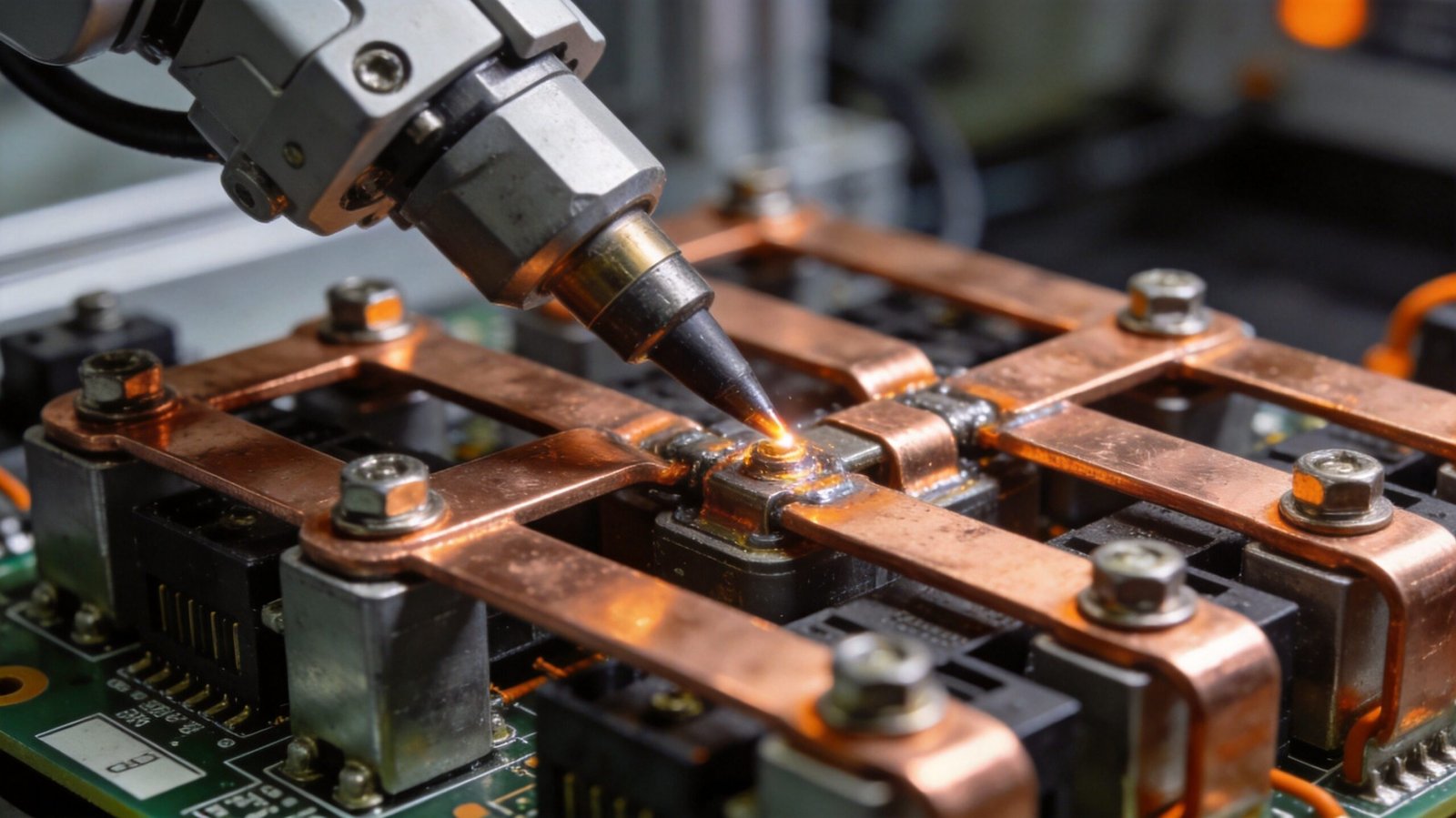

UNIX-Compatible Soldering Tips for a U.S. Consumer Electronics Assembly Plant
Case study — United States · Consumer electronics · UNIX robotic soldering (200W CROSS-HEATER)
| Project facts | Details |
|---|---|
| Customer | A consumer-electronics contract manufacturer (EMS) in the Western U.S. (name withheld) |
| Products | Smart-home and IoT device board assemblies |
| Equipment | UNIX automatic soldering robots with 200W CROSS-HEATER |
| Tips involved | P2D-S narrow bevel cross-bit integrated tips, P13DVAP V-shape |
| Pain point | Yield drift on dense boards, short tip life, downtime on tip changes |
| Outcome | Stable joints on fine pitch, longer service intervals, fewer changeovers |
Customer Background
The EMS plant assembles high-volume IoT and smart-home boards for several brands. Product mix changes frequently, but the common thread is dense, compact PCBAs with fine-pitch connectors and small SMD devices. Their lines run UNIX soldering robots equipped with 200W CROSS-HEATER integrated systems.
As a contract manufacturer, this customer competes on yield and uptime. A consumable that quietly erodes either one directly hits margins — which is exactly what was happening.
The Problem: Yield Drift and Frequent Tip Changes
Process engineering traced a persistent tail of defects — peaked solder, occasional cold joints on dense boards, and solder bridges on fine-pitch rows — back to the tips rather than the machine program. Root causes:
- Tip geometry not matched to the joint. A broad working face on a dense board was disturbing adjacent pads, while insufficient heat concentration caused intermittent wetting on small joints.
- Short service life in high-volume duty. Tips were being changed more often than planned. Every change on an inline robot means stopping the cell, swapping the consumable, and re-checking program position — downtime that propagates up and down the line.
- Compensating with temperature. Operators had nudged set temperatures upward to force wetting, which accelerated plating wear and made the drift worse.
Requirements
- Integrated tips built specifically for the UNIX 200W CROSS-HEATER system
- Precision geometry that concentrates heat on small, dense joints without touching neighbors
- Heavy plating that survives continuous lead-free duty at correct (not inflated) temperatures
- A supplier that understands automated production, not just catalog sales
- Predictable availability to keep high-volume cells running
Our Solution
1. Re-specifying geometry around the actual joints. For the dense fine-pitch work we supplied the P2D-S narrow bevel cross-bit integrated tip — a φ2mm, 0.5mm-thick narrow profile with an 8mm front length that concentrates heat precisely on the target joint and clears surrounding components. For the V-groove connector passes we provided the P13DVAP V-shape precision tip, whose groove channels accurate solder volume onto fine-pitch rows in a single pass.
2. Materials for a 200W heater. Both tips use a high-purity oxygen-free copper core (Cu ≥ 99.97%) for instant thermal response and recovery between short machine cycles, with multi-layer iron plating and a lead-free-compatible working surface. Fast recovery is what lets the line hold 2–3 second joints without raising temperature.
3. Fixing the process, not just the part. We advised bringing set temperatures back into the correct lead-free window (roughly 320–360°C for the application) and matching the largest working face that wets the joint in 2–3 seconds — the opposite of “hotter fixes everything.” The temperature/plating/lifespan relationship is covered in our automatic soldering tip selection guide.
4. Quality control per batch. Tips undergo V-angle, groove-depth and symmetry inspection, plating-thickness control, and surface-defect checks before shipment, with batch traceability.
Results
| Metric | Outcome |
|---|---|
| Fine-pitch defects | Peaked solder and bridges reduced after geometry correction |
| Wetting stability | Reliable joints held at correct (lower) temperatures |
| Tip service interval | Longer between changes with properly specified plating |
| Line downtime | Fewer changeovers and program re-checks |
| Operator behavior | Temperature pushed back into the recommended window |
| Supply | Stable, repeatable shipments to match high-volume schedules |
For an EMS operation, the value was not a cheaper tip on paper — it was more good joints per hour and fewer stoppages, which is where a contract manufacturer actually makes money.
Why It Worked
The customer initially believed they had a machine or operator problem. They actually had a tip-geometric and plating problem that the wrong temperature setting was hiding. Matching the narrow cross-bit and V-groove profiles to the real joints, then taking temperature back to spec, addressed both yield and tip life at the same time.
When standard catalog shapes cannot reach a crowded joint, we also engineer custom profiles — see our 480°C high-temperature custom tip case for a Korean electronics plant.